






By Matt Ruggieri, Co-founder & Head of Product Development, Onekind
Quick Answers
What does tonka bean smell like?
Tonka bean smells warm, creamy, and sweet — with natural notes of vanilla, almond, and a faint hint of spice. It's richer and more complex than vanilla alone, with a slightly powdery depth that makes it smell expensive and long-lasting. Most people describe it as addictive: familiar enough to be comforting, unusual enough to be impossible to stop smelling.
Is tonka bean the same as vanilla?
Not exactly. Both contain coumarin — the compound responsible for their shared warmth and sweetness — but tonka bean is more complex. Where vanilla is soft and straightforward, tonka has additional layers: almond, hay, a subtle spice, and an almost tobacco-like depth that develops over time. In fine fragrance, they're often used together because they make each other better.
What is a gourmand fragrance?
A gourmand fragrance is one built around edible-smelling notes — vanilla, caramel, chocolate, tonka, praline. The category emerged in the early 1990s and has been growing ever since. Gourmands don't smell like food exactly; they smell like the warm, cozy feeling associated with food. Tonka bean is one of the category's most versatile building blocks because it adds sweetness without becoming cloying.
Is tonka bean safe for sensitive skin?
In a well-formulated perfume oil, yes. Tonka bean absolute is derived from the seed of the Dipteryx odorata tree and is generally well-tolerated on skin, especially in an oil base without alcohol. The format matters: alcohol-based sprays can cause irritation on sensitive skin regardless of the notes; a perfume oil like Tonka Daze uses fractionated coconut oil as the carrier, which is non-irritating and skin-friendly.
There's a moment in perfumery where something clicks and you understand why a note has lasted centuries. I had that moment with tonka bean.
I'd been sourcing ingredients for what would become Tonka Daze Perfume Oil, and I kept coming back to tonka absolute — not vanilla, not benzoin, not any of the more familiar gourmand building blocks. Tonka specifically. The more I worked with it, the more I understood why perfumers have been reaching for it since the 1800s. It does something no other ingredient quite replicates.
Here's what I've learned about it.
What Is Tonka Bean?
Tonka bean is the seed of the Dipteryx odorata tree, native to Central and South America. The seeds are harvested, dried, and cured — a process that concentrates coumarin, the organic compound responsible for tonka's characteristic scent. Coumarin smells warm, sweet, and slightly spicy. It's also found in vanilla, cinnamon, lavender, and freshly cut grass, which explains why tonka feels simultaneously familiar and hard to place.
In perfumery, tonka is used in two main forms: tonka absolute (a thick, dark extract that captures the full complexity of the seed) and synthetic coumarin (isolated from its natural source and used for consistency). For Tonka Daze, I use tonka bean absolute — the natural form — because the synthetic version flattens out the almond and hay facets that make tonka genuinely interesting.
The result is a material that smells like vanilla's more sophisticated older sibling: warmer, more layered, with a depth that develops slowly on skin rather than hitting all at once and fading.
Why Gourmand Fragrances Are Having a Moment
Gourmand fragrance — the category built around edible-smelling notes like vanilla, caramel, chocolate, and tonka — has been one of the fastest-growing areas in perfumery for the last decade. But it's not new. The category was essentially invented in 1992 with Thierry Mugler's Angel, which combined chocolate, caramel, and musk in a way that was genuinely shocking at the time. Perfumery had been dominated by florals and chypres for decades. Something that smelled like dessert was almost transgressive.
What's changed since then isn't the appetite for gourmand notes — that was always there. What's changed is sophistication. The early gourmands could be cloying, one-dimensional, relentlessly sweet in a way that exhausted you within an hour. The modern ones — including Tonka Daze Perfume Oil — are built differently. The sweetness is balanced. The base notes ground it. The complexity keeps you interested rather than overwhelmed.
Tonka bean is central to that evolution because it's sweet without being saccharine. The almond and hay notes add nuance. The coumarin warmth reads as intimate rather than edible. It smells like comfort, not candy.
The Tonka Daze Composition: How It Was Built
Every fragrance I make starts with a clear brief: what is this scent trying to be? What feeling, what memory, what experience is it reaching for?
For Tonka Daze, the brief was: the fragrance equivalent of the hour before midnight. Warm, seductive, a little hazy. Something that makes you feel like the best version of yourself without announcing it too loudly.
Tonka bean absolute anchors the whole composition. Around it:
- Natural vanilla absolute — supports the tonka's sweetness and rounds out the opening. Natural vanilla is darker and more complex than synthetic vanillin, with a faint woodiness that keeps it from reading as pure confection.
- Sandalwood — a warm, creamy base that extends the whole composition and makes it last longer on skin. It also adds an intimacy that makes the fragrance feel skin-close rather than perfume-forward.
- Cardamom — the spice element that cuts through the sweetness and adds a slight green, aromatic edge. Without it, the composition would be too soft. Cardamom gives it a backbone.
- Jasmine and orange blossom — floral lifts that keep the heart from feeling too heavy. They're not dominant, but they're essential — they create the brightness that stops Tonka Daze from sitting entirely in the base register.
- Orris root — a rare, expensive ingredient extracted from iris root. Orris has a powdery, slightly violet quality that bridges the floral notes and the base. It's what gives the dry-down its distinctive softness.
The result opens with cardamom and a hint of floral, settles into the warm tonka-vanilla-sandalwood heart within about twenty minutes, and lingers there for hours. It's a linear composition in the best sense — not many sharp transitions, just a steady deepening into something that smells better and better as it warms on your skin.
Why Perfume Oil Format Changes Everything
Tonka and vanilla are notes that can go wrong in an alcohol spray. The drydown — that critical period after the alcohol evaporates and the base notes emerge — can turn sweet and cloying if the formula isn't carefully balanced. You end up smelling like a candle store, which is the opposite of what a sophisticated gourmand is supposed to achieve.
Oil format solves this problem almost entirely. There's no alcohol evaporation, no sharp opening burst, no dramatic drydown. Tonka Daze Perfume Oil develops slowly and continuously from the moment you apply it — the cardamom is present from the start, the tonka and vanilla deepen gradually, the sandalwood becomes more prominent over the first hour. The sweetness is always there, but it never overwhelms because it never gets the dramatic release that alcohol creates.
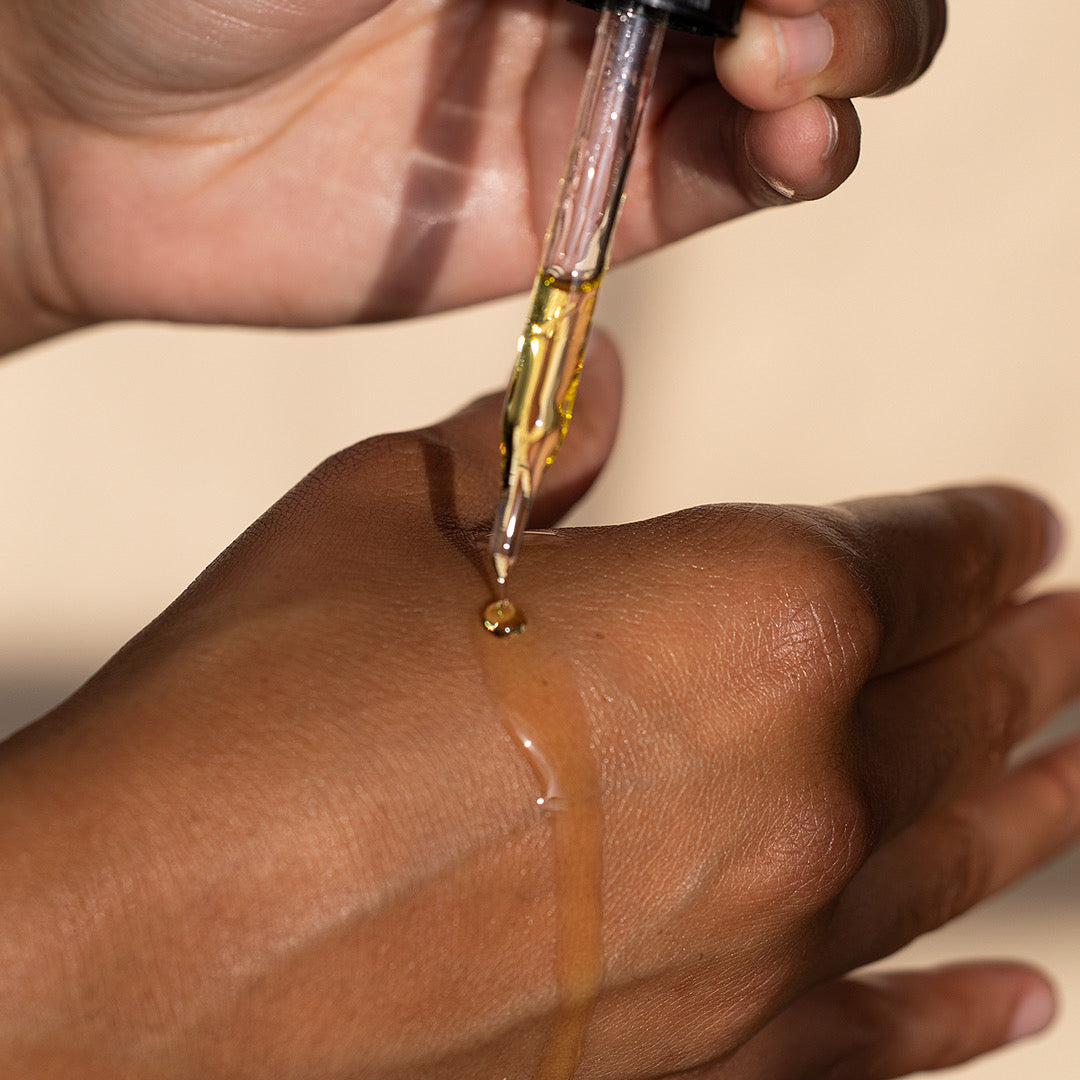
The oil carrier also matters. We use fractionated coconut oil — lightweight, odorless, non-greasy — which carries the fragrance without adding its own character. It's also non-irritating and skin-friendly, which matters if you're applying to your neck and wrists every day. Fractionated coconut oil actually helps the fragrance last longer on skin by creating a moisture barrier that slows evaporation. You get six to eight hours of genuine wear from two to three drops.
When and How to Wear Tonka Daze
Gourmand fragrances have a reputation as evening scents — date night, dinner, occasions where warmth and intimacy are appropriate. Tonka Daze fits that context beautifully. Body heat amplifies the vanilla and tonka at night, and the closeness of other people in an evening setting lets the fragrance do exactly what it was designed to do.
But I wear it during the day too, and I'd push back on the idea that gourmands belong exclusively in the evening. The oil format keeps the projection intimate — it doesn't fill a room, it radiates from your skin. In a daytime context, that reads as polished rather than indulgent. The cardamom and sandalwood in the composition add structure that keeps it from feeling purely dessert-like, and by the time it's settled into the dry-down, it's more warm-skin-with-depth than recognizably sweet.
Application is straightforward: two to three drops from the rollerball, applied to pulse points — inner wrists, base of the neck, the soft skin inside the elbow. Warm spots, where body heat will gently amplify the scent throughout the day. Don't rub the wrists together after applying; it crushes the top notes and changes how the fragrance develops. Just let it sit.
For evening wear or occasions where you want more presence, apply a drop to the back of the neck as well. That pulse point projects more as your body temperature rises through an evening, and it means the scent reaches people as they get close to you — which is exactly where a fragrance like this should live.
Layering Tonka Daze With Other Scents
Tonka bean is one of the most versatile layering bases in the Onekind collection. Because it sits in the base register — warm, sweet, grounding — it extends and deepens almost anything layered on top of it.
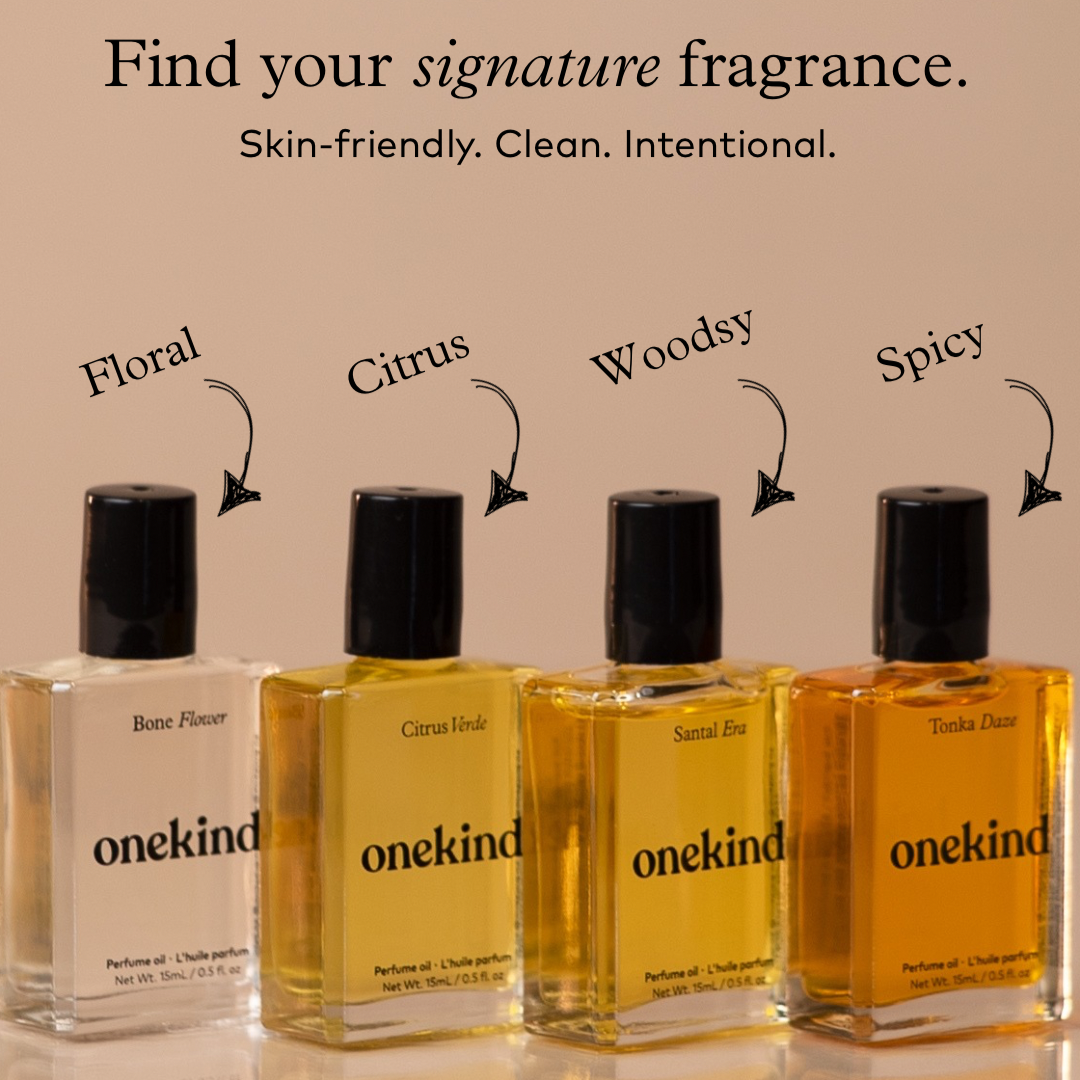
Tonka Daze + Santal Era: Two warm base notes that reinforce each other. The result is deeper and more complex than either alone — the sandalwood in Santal Era merges with the sandalwood in Tonka Daze, the vanilla adds richness, and the cardamom adds a spice element you don't get from either individually. This is my personal favorite combination.
Tonka Daze + a citrus cologne: Apply a citrus spray first, let it dry completely, then layer Tonka Daze Perfume Oil on top. The citrus gives you a bright, fresh opening; the tonka gives you a warm, lasting dry-down. The combination smells significantly more expensive than either component.
Tonka Daze alone: Completely legitimate. The composition is designed to work as a complete fragrance on its own — you don't need to layer it to get something interesting. The opening cardamom note, the vanilla-tonka heart, the sandalwood base: it tells a full story by itself.
What Makes Tonka Daze Different
I've smelled a lot of tonka fragrances. Most of them make the same mistake: they lead with vanilla and use tonka as a supporting player, treating it as a way to add depth to something that's fundamentally a vanilla fragrance.
Tonka Daze Perfume Oil inverts that. Tonka absolute is the featured material. The vanilla supports it, not the other way around. That decision changes the character of the whole fragrance — it's warmer, slightly more complex, with the almond and hay facets of tonka coming through in a way that gets lost when vanilla dominates.
Combined with the oil format and the intentional composition built around it, the result is something I'm genuinely proud of. It's the gourmand fragrance I wanted to exist and couldn't find anywhere else. If that sounds like the kind of thing you'd wear, Tonka Daze is here.
Written by Matt Ruggieri, Co-Founder & Head of Product Development at Onekind, with 15+ years of experience in beauty product formulation and development.