



The format of a fragrance changes everything — how it smells on your skin, how long it lasts, how it interacts with your body chemistry. Perfume oil and spray perfume start from the same raw materials but deliver a completely different experience.
The Base Makes All the Difference
Spray perfumes — whether EDP, EDT, or EDC — use alcohol as the carrier. The alcohol does two things: it helps the fragrance project off the skin immediately, and then it evaporates. That evaporation is fast, and it takes some of the fragrance with it.
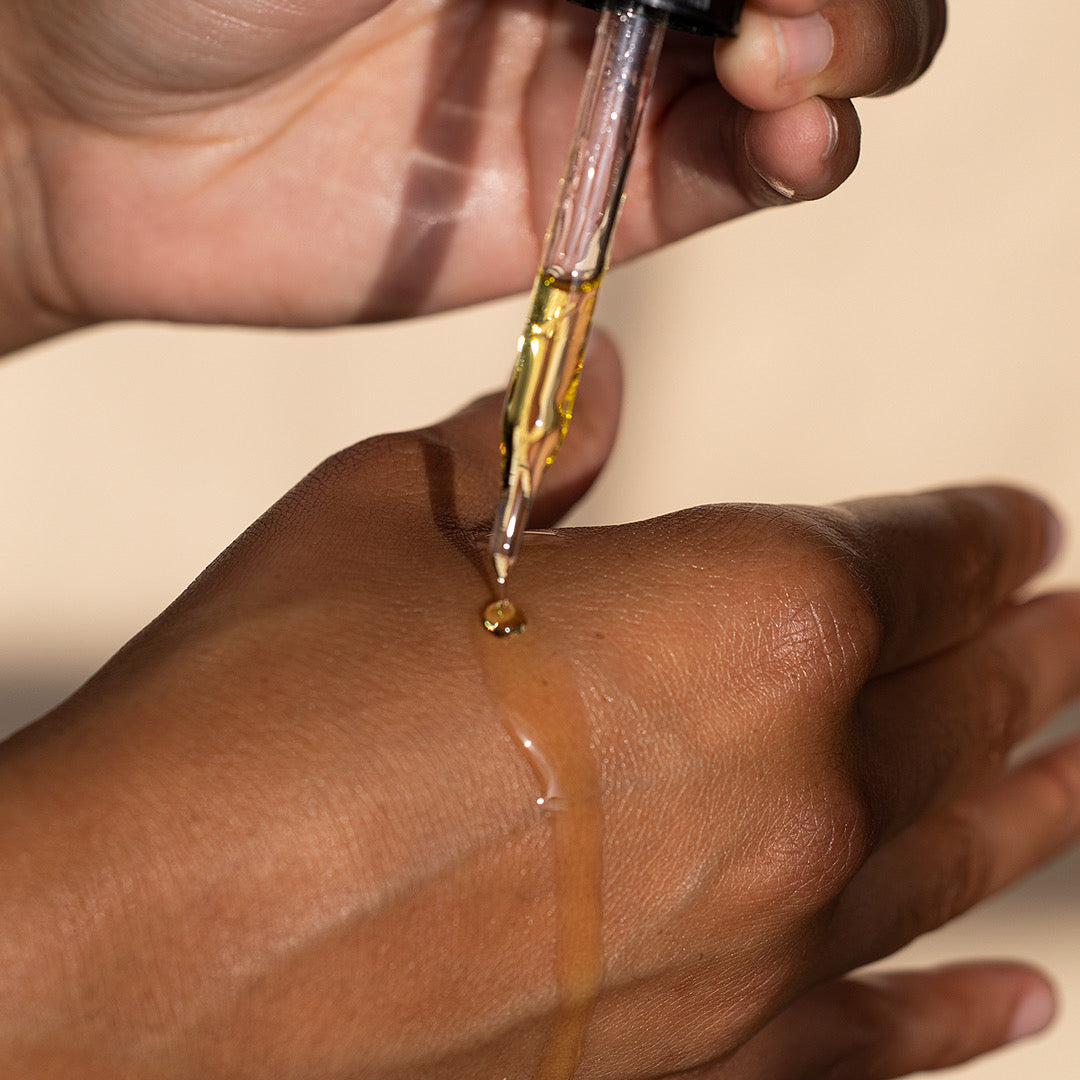
Perfume oils use a carrier oil instead — typically jojoba, fractionated coconut oil, or a similar lightweight base. There's no alcohol, which means no evaporation. The fragrance stays on the skin and releases slowly as your body warms it. That single difference in base drives nearly every other distinction between the two formats.
How They Smell Different
With a spray, you get an immediate burst. The projection is strong — top notes hit hard in the first few minutes, then the alcohol evaporates and the scent settles. What you smell in the bottle is close to what you'll experience in the opening. It's bold and legible from a distance.
With oil, the reveal is slower. The scent warms with your skin and develops over 30 to 60 minutes. The top notes are present but subtler at first. The heart and base emerge gradually. The result is what perfumers call a skin scent — close to the body, intimate, and personal.
Because oil interacts with your skin's natural chemistry rather than projecting over it, the same fragrance can read slightly differently on two people. That's not a flaw. It's part of what makes oil-based fragrance feel individual.
Longevity — Which Lasts Longer?
Perfume oil generally outlasts an equivalent spray. Without alcohol to accelerate evaporation, the scent has nowhere to go except deeper into the skin. Applied to pulse points on moisturized skin, a well-formulated perfume oil typically lasts 6 to 10 hours.
An EDP — the highest-concentration spray format — typically lasts 4 to 8 hours. EDTs run 3 to 5 hours. EDCs fade faster still. The longevity gap between perfume oil and spray widens as concentration decreases.
The other variable is skin hydration. Dry skin absorbs oil quickly and reduces wear time noticeably. Moisturized skin holds the fragrance at the surface and extends it.
The Sensitivity Question
Alcohol is a common irritant for sensitive and reactive skin. It strips the moisture barrier and can cause dryness, tightness, or a stinging sensation — most noticeably on the neck and wrists, which are exactly where most people apply fragrance. For anyone with reactive skin, even a well-formulated EDP can cause problems on those areas.
Perfume oil eliminates this entirely. The carrier oil base is non-drying and doesn't compromise the skin barrier. It's the same reason skincare formulations designed for sensitive skin tend to avoid high concentrations of alcohol.
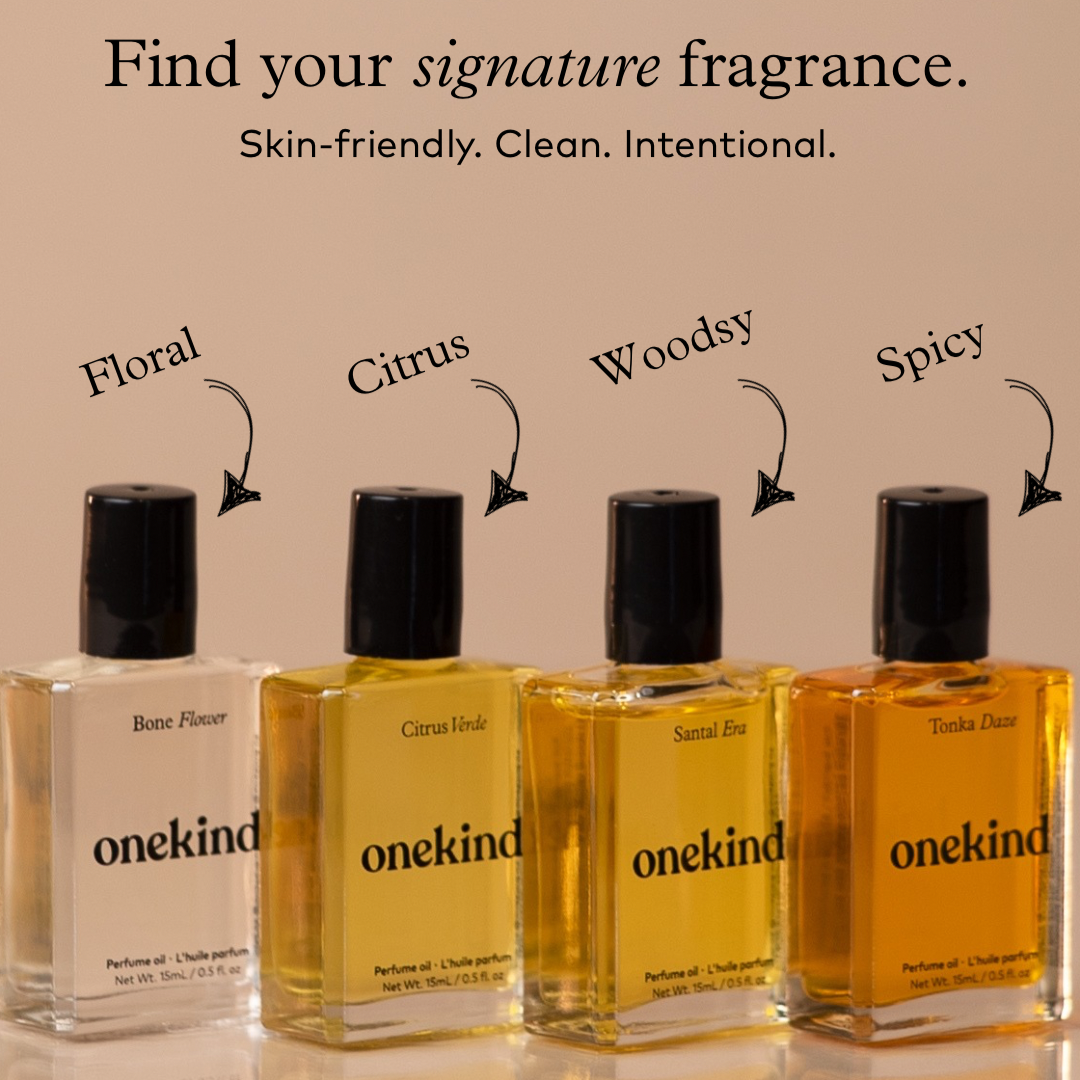
One important clarification: this doesn't mean every perfume oil is automatically gentle. The fragrance compounds themselves can still cause sensitivity in some people. The oil format removes one known irritant (the alcohol), but the formula still matters. Onekind's perfume oils — Santal Era, Tonka Daze, Bone Flower, and Citrus Verde — are free of synthetic fragrance and formulated with sensitive skin in mind.
Projection vs. Skin Scent
This is where personal preference matters most. Spray perfume is designed to project — to fill a space, to be noticed across a room, to announce itself. For certain occasions and certain aesthetics, that's exactly right.
Perfume oil works differently. The sillage (the trail a fragrance leaves) is closer to the body. People notice it when they're near you. It's the kind of scent that prompts someone to lean in and ask what you're wearing. More intimate. More yours.
Neither is better. They serve different intentions.
Price Per Wear
The sticker price on a perfume oil is often higher per milliliter than a comparable spray. That comparison is misleading without factoring in usage.
A 10ml perfume oil, applied at 1 to 2 drops per application, yields roughly 100 to 200 wears. A 50ml EDP at 3 to 4 sprays per application yields somewhere in the same range — but the EDP costs considerably more for that volume. The math on perfume oil is better than it looks at first glance. The price per wear tends to be lower, even when the price per ml is higher.
Small bottles are also more practical. They travel easily, fit in a pocket, and don't require careful packing.
Which Format Is Right for You?
- Sensitive or reactive skin → perfume oil
- Prefer bold, projecting scent → spray
- Want a signature skin scent that evolves → perfume oil
- Want to layer multiple fragrances → perfume oil
- Prefer familiar spray application → spray
- Looking for longer wear → perfume oil
- Want fragrance that fills a room → spray
- Prefer something intimate and personal → perfume oil
If you're looking for a place to start: Santal Era is warm, woody, and wearable year-round — a good first oil if you're new to the format. Tonka Daze leans sweeter and gourmand, best in fall and winter. Bone Flower is the clean, white-floral option — understated and easy to layer. Citrus Verde is the lightest of the four, bright citrus and herbal, ideal for warmer months.
Frequently Asked Questions
What is the difference between perfume oil and spray perfume?
The primary difference is the carrier. Spray perfumes use alcohol, which projects the scent and then evaporates quickly. Perfume oils use a carrier oil — typically jojoba or fractionated coconut oil — which keeps the scent close to the skin and releases it slowly over time. This affects projection, longevity, skin feel, and how the fragrance develops.
Does perfume oil last longer than spray?
Generally, yes. Without alcohol to speed evaporation, perfume oil stays on the skin longer. A well-applied perfume oil can last 6 to 10 hours on moisturized skin. An EDP (the most concentrated spray format) typically lasts 4 to 8 hours; lighter concentrations like EDT fade faster. Skin hydration plays a significant role in both formats.
Is perfume oil better for sensitive skin than spray?
For most people with sensitive or reactive skin, yes. Alcohol — the carrier in spray perfumes — is a common skin irritant that can cause dryness, redness, and stinging, particularly on the neck and wrists. Perfume oil eliminates that variable entirely. That said, the fragrance ingredients themselves can still cause sensitivity; the carrier being oil-based doesn't automatically make the formula safe for everyone.
How do you apply perfume oil vs. spray?
Spray perfume is applied at arm's length — a mist to the neck, wrists, or chest. Perfume oil is applied by pressing or dabbing 1 to 3 drops directly onto pulse points. Don't rub perfume oil in; pressing allows the scent to absorb naturally without breaking down the fragrance molecules. Both benefit from moisturized skin and pulse point application.
Can perfume oil replace my regular perfume?
Yes, with the understanding that the experience is different. If you value projection and immediate impact, spray has an advantage. If you prefer longer wear, a scent that evolves on the skin, or a format that works better for sensitive skin, perfume oil is a complete alternative — not a compromise. Many people switch and don't go back.
Is perfume oil the same as an essential oil?
No. Essential oils are single-ingredient botanical extracts — eucalyptus, lavender, peppermint, and so on. Perfume oils are formulated fragrances: a blend of aromatic compounds suspended in a neutral carrier oil. Essential oils are typically not skin-safe at full concentration and aren't designed to be worn as fragrance. Perfume oils are formulated specifically for skin application.
Onekind makes four perfume oils — Santal Era, Tonka Daze, Bone Flower, and Citrus Verde — each free of synthetic fragrance and formulated for direct skin use. Explore the full fragrance collection.
Written by Matt Ruggieri, Co-Founder and Head of Product Development, Onekind.
Written by Matt Ruggieri, Co-Founder & Head of Product Development at Onekind, with 15+ years of experience in beauty product formulation and development.