






Quick Answer
For sensitive skin, fragrance oils are typically better tolerated than alcohol-based spray perfumes. Spray perfumes use ethyl alcohol as their main carrier — which can dry and irritate reactive skin — and frequently contain synthetic fragrance compounds that are among the most common causes of contact dermatitis. Fragrance oils are diluted in a skin-compatible carrier oil, contain no alcohol, and sit close to skin rather than projecting aggressively. Look for fragrance oils that list their full ingredient set, since some still contain synthetic compounds.
By Matt Ruggieri, Co-founder & Head of Product Development, Onekind
Finding a perfume for sensitive skin that actually works — one that lasts, smells genuinely good, and doesn't trigger a reaction — is harder than it should be. The fragrance industry has largely solved for projection and longevity in spray formats, but those formats come with trade-offs that people with sensitive skin know well: the burning sensation on freshly applied skin, the headache from a heavy ethanol cloud, the redness that shows up a few hours after application. Most people with sensitive skin have learned to live with fewer fragrance options than everyone else, or to avoid them entirely.
I built Onekind's fragrance line to solve that problem specifically. Here's what's actually going on with traditional perfume and sensitive skin — and why the format matters as much as the formula.
Why Traditional Spray Perfumes Are Hard on Sensitive Skin
Spray perfumes are alcohol-based. The alcohol serves a purpose — it's the carrier that allows fragrance to atomize into the air and creates that immediate burst of scent. But alcohol is also a known skin irritant, particularly for sensitive, dry, or reactive skin. It strips away surface lipids, causes transepidermal water loss, and can trigger visible redness in people whose skin barrier is already compromised.
The concentration of fragrance materials in spray perfumes adds another layer of complexity. To preserve the alcohol base and ensure stability, most spray perfumes use a relatively high ratio of synthetic aroma compounds that are optimized for airborne projection — not for extended contact with skin. Some of these compounds have known sensitizing potential, which is why the fragrance industry's self-regulatory body (IFRA) maintains a list of restricted ingredients. Even compliant formulas can be challenging for people with reactive skin because of the sheer volume of materials in contact with the skin over hours of wear.
The result: spray perfume and sensitive skin have an uneasy relationship that the industry hasn't done much to address. The answer isn't to give up on fragrance — it's to change the format.
What Makes a Fragrance Oil Different
A fragrance oil replaces the alcohol carrier with a skin-friendly oil base. In Onekind's perfume oils, that base is fractionated coconut oil — a highly refined, lightweight form of coconut oil that's odorless, non-greasy, and has an excellent skin tolerance profile. It doesn't carry the irritation risk of ethanol and doesn't strip the skin barrier.
The oil base changes how the fragrance behaves on skin in several meaningful ways:
Longevity. Oil doesn't evaporate the way alcohol does. Where an alcohol-based spray launches fragrance into the air quickly — strong at first, fading over hours — a perfume oil releases its scent slowly and continuously as the oil warms against skin. The result is 6–10 hours of skin-close wear rather than a short burst followed by decline.
Skin feel. Oil-based fragrance is applied directly to pulse points — wrists, neck, behind the ears — in small, intentional amounts via rollerball. It absorbs into skin rather than sitting on top of it or dispersing into the air. The experience is intimate and personal rather than projecting outward.
Scent development. Because oil slows the volatilization of fragrance materials, oil-based fragrances tend to develop more of their mid and base notes on skin. The heart and dry-down of a fragrance — the parts that make it interesting and complex — are more fully expressed in an oil format than in a spray.
For more on why the format switch matters, see 7 Reasons to Ditch Spray Perfumes for Oils.

Why I Built the Onekind Fragrance Line Around Oil
The brief I gave myself when developing Onekind's fragrance collection was simple: fine fragrance that works for sensitive skin without compromise on quality or longevity. Not a "sensitive skin version" of a real fragrance — just fragrance that's genuinely good and genuinely wearable for people who've been left out of the category.
The oil format was the obvious foundation. Fractionated coconut oil as the carrier gives us a stable, skin-compatible base that doesn't require the preservatives or fixatives that alcohol-based formulas do. It also gives us a rollerball delivery format that puts the wearer in control of exactly how much and where — which is both more intentional and more skin-friendly than a spray.
For the fragrance materials themselves, I worked with perfumers on compositions that prioritize naturals — natural sandalwood, vanilla absolute, tonka bean absolute, rose, jasmine, tuberose — not because naturals are inherently safer, but because they tend to have a warmth and complexity that synthetic-heavy fragrances don't. Each scent in the line is built around a specific mood and a specific progression from top to base, in the way fine fragrance should work.
The result is a collection of four distinct perfume oils — each one a genuine fine fragrance — that happen to be significantly more compatible with sensitive skin than what most of the industry offers.
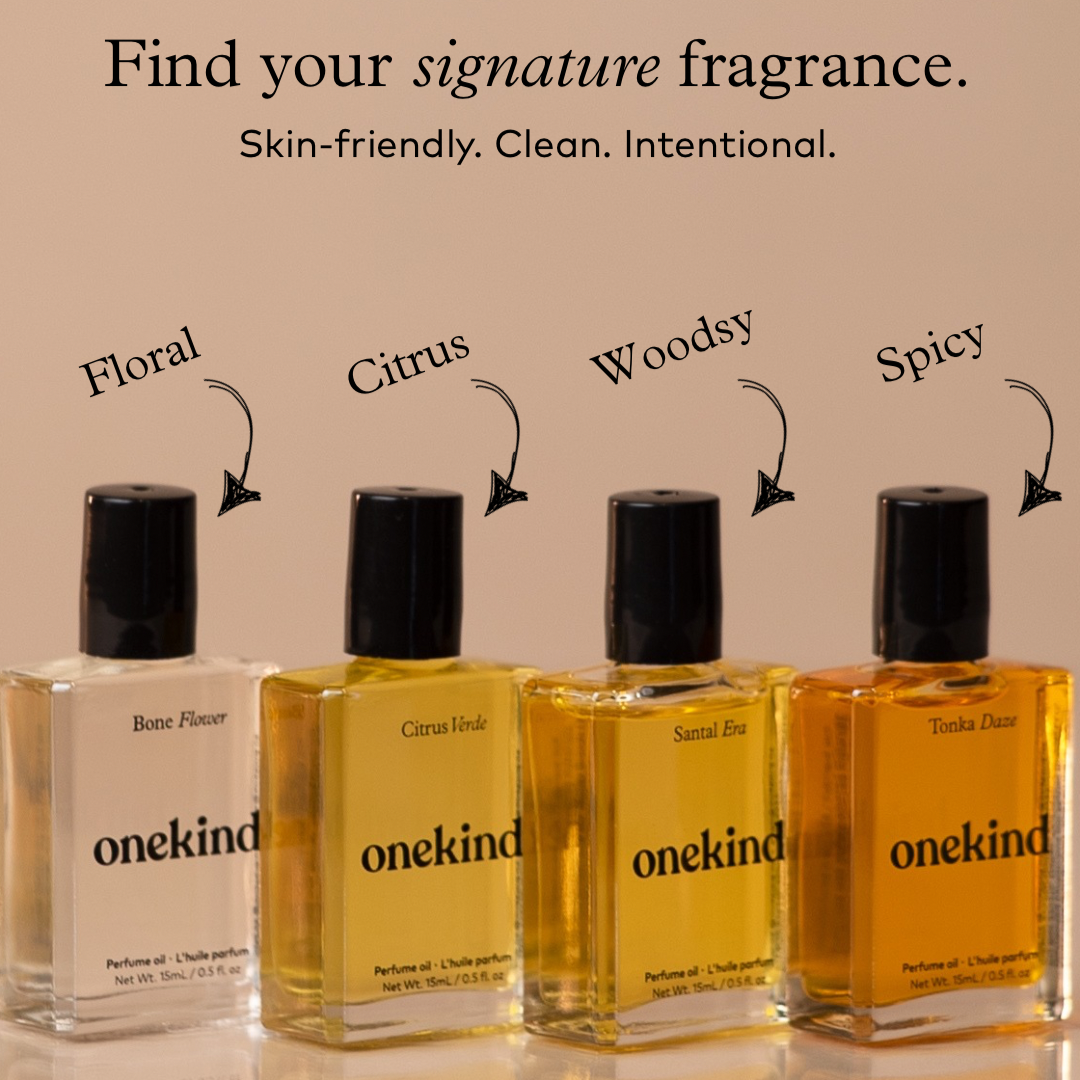
The Onekind Perfume Oil Collection
Santal Era Perfume Oil — $65
The most skin-like scent in the collection. Santal Era Perfume Oil opens with sweet violet and a hint of cardamom, deepens into warm leather and amber, and settles into a soft, lingering musk that evolves with your skin chemistry throughout the day. The sandalwood base is what makes it feel intimate rather than perfume-y — it wears like an elevated version of your own skin rather than something applied on top of it. Gender-free. The most universally wearable scent in the collection. For a deeper look at the sandalwood category, see What Is a Santal Scent?
Tonka Daze Perfume Oil — $65
Not basic vanilla. Tonka Daze Perfume Oil is built around natural vanilla absolute and tonka bean absolute — two of the richest, most complex materials in perfumery. Warm sandalwood and orris root form the base; cardamom adds spice; jasmine and orange blossom lift the whole composition into something deeply sensual and unforgettable. It wears close to skin, getting better as the day progresses. If you're drawn to gourmand fragrances but find most of them too sweet or synthetic, Tonka Daze is the answer.
Bone Flower Perfume Oil — $65
The most opulent scent in the collection. Bone Flower Perfume Oil opens with tuberose, jasmine, and Turkish rose — the most intoxicating flowers in the perfumer's palette — and settles into a complex base of natural sandalwood and patchouli, lifted by the bright heat of pink peppercorn. It's passionate and sophisticated in a way that most floral fragrances aren't. The oil format allows the floral heart to develop slowly rather than arriving all at once, which is where the complexity comes from.
Citrus Verde Perfume Oil — $65
The freshest and most refined scent in the collection. Citrus Verde Perfume Oil opens with vibrant bergamot and clean matcha — bright, invigorating, and effortlessly elegant. Herbal yerba mate and cardamom add a unique green warmth as it evolves; then grounding cedarwood and soft musk settle into a skin-close finish that lasts. If you love clean, elevated, green citrus fragrances but find most of them too sharp or fleeting in spray format, the oil base solves both problems.

How to Apply Perfume Oil
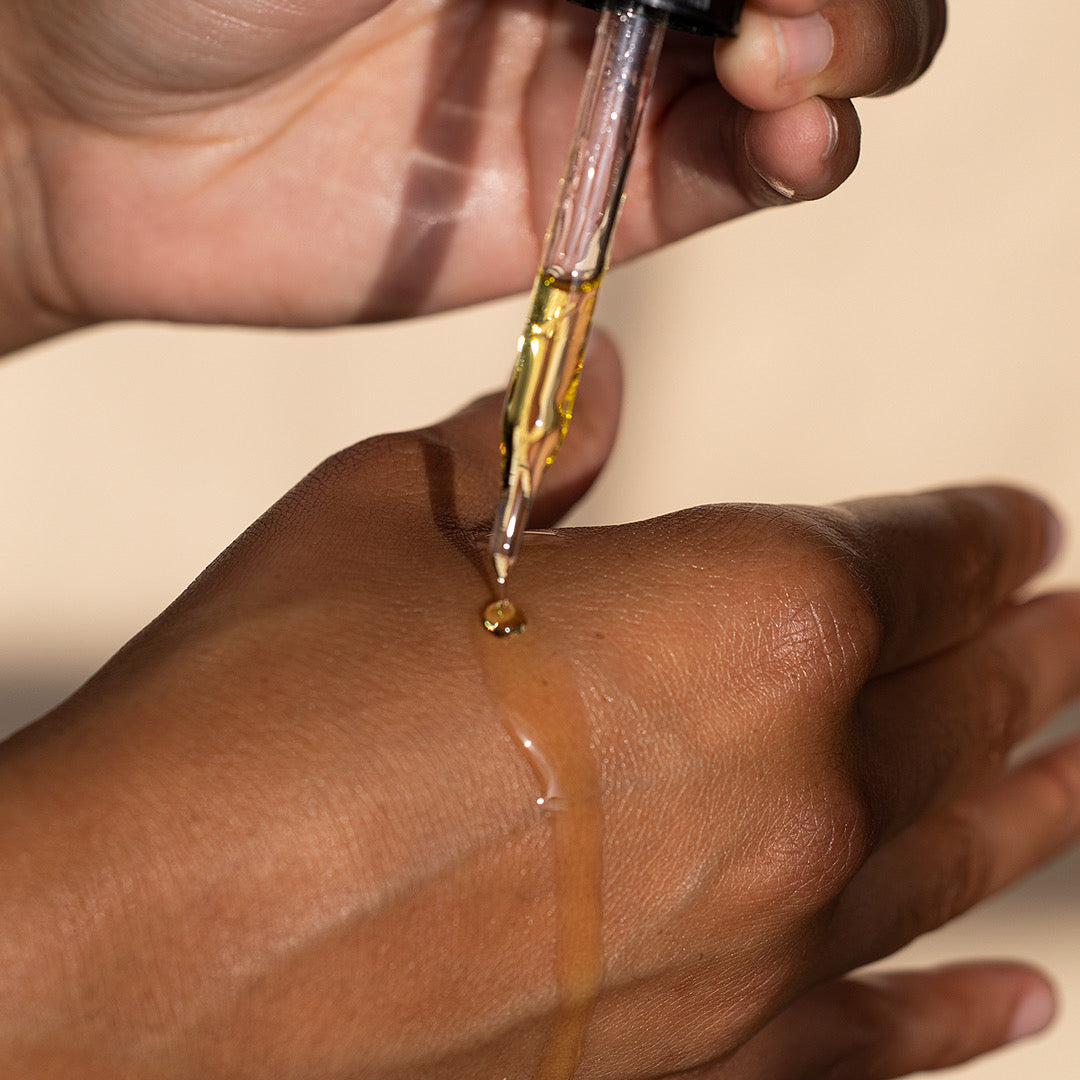
Perfume oil is applied differently than spray perfume — and that difference is part of what makes it so wearable for sensitive skin. Each Onekind perfume oil comes in a travel-ready rollerball, which gives you direct, precise application to pulse points without any overspray or airborne dispersion.
Apply to wrists, the inside of the elbow, the base of the neck, and behind the ears — wherever your skin is warmest. The warmth activates the oil and releases the fragrance gradually. Start with light application and build from there. A little goes further than you expect because the oil base holds and develops the scent over hours rather than fading quickly.
One thing to avoid: rubbing your wrists together after application. It's a reflex from spray perfume habits, but with an oil-based fragrance it crushes the top notes before they have a chance to develop properly. Roll on and let it sit.
For guidance on building a layered scent wardrobe with multiple oils, see How to Layer Perfume Oils to Create Your Signature Scent.
Shop the Signature Fragrance Collection — $195
Frequently Asked Questions
Is perfume oil better for sensitive skin than spray perfume?
For most people with sensitive skin, yes. The primary irritant in traditional spray perfume is ethanol — the alcohol carrier that allows the fragrance to atomize. Ethanol can strip skin lipids and trigger visible redness in people with sensitive or reactive skin. Fragrance oils replace ethanol with a skin-friendly oil carrier — in Onekind's case, fractionated coconut oil — which doesn't carry the same irritation risk and doesn't require the same volume of synthetic fixatives to remain stable.
How long does a perfume oil last on skin?
A high-quality perfume oil like Onekind's collection typically lasts 6–10 hours on skin. The oil base is the key factor: because it doesn't contain alcohol, it adheres to skin rather than evaporating quickly. The fragrance is released gradually as the oil warms against your pulse points, which means the scent builds and develops over hours rather than peaking at application and fading.
What scents are best for sensitive skin?
The format matters more than the specific notes. An oil-based fragrance in a skin-friendly carrier is going to be gentler on sensitive skin than an alcohol-based spray regardless of the scent profile. Within the Onekind collection, Santal Era Perfume Oil tends to be the most universally skin-compatible — sandalwood and musk are among the lowest-risk fragrance categories. Citrus Verde Perfume Oil is the lightest and freshest option if you prefer a less intense wearing experience.
Can I wear perfume oil if I have eczema or rosacea?
We always recommend testing any new fragrance product on a small area of skin before full application — this is true for all fragrance, regardless of format. That said, the oil-based format is generally considered gentler than alcohol-based spray alternatives because it doesn't contain ethanol and doesn't disperse fragrance materials directly onto large areas of skin. The rollerball format also allows you to apply small, controlled amounts to pulse points away from any particularly reactive areas.
Do perfume oils stain clothing?
Onekind's perfume oils are designed for direct skin application — wrists, neck, and pulse points — rather than clothing. Applied to skin, they absorb without leaving an oil residue. Applying directly to fabric is not recommended, as any oil-based product carries some risk of marking fabric. The rollerball delivery format makes it easy to apply precisely to skin without contact with clothing.
What is fractionated coconut oil and why is it used in perfume oil?
Fractionated coconut oil is a refined form of coconut oil from which the long-chain fatty acids have been removed, leaving a lightweight, odorless, and stable carrier oil. Unlike regular coconut oil, it stays liquid at room temperature, absorbs quickly into skin, and has no scent of its own — which means it doesn't interfere with the fragrance composition. It also has a long shelf life without oxidizing. For fragrance, it's one of the most skin-compatible carriers available, which is why Onekind uses it as the base for the entire perfume oil collection.
Can I layer Onekind perfume oils?
Yes — the oil format is ideal for layering because each scent develops close to skin, so combinations are subtle and personal rather than competing or overwhelming. Santal Era Perfume Oil and Tonka Daze Perfume Oil layer particularly well — the sandalwood base in Santal Era deepens the vanilla warmth of Tonka Daze. For a complete guide to layering, see How to Layer Perfume Oils to Create Your Signature Scent.
Matt Ruggieri is the Co-founder and Head of Product Development for Onekind. With over 15 years of experience, Onekind makes skin-friendly perfume oils and skincare products developed for sensitive skin.

For a warm, skin-close option, Santal Era Perfume Oil is formulated specifically for sensitive skin -- free of synthetic fragrance, alcohol-free, and built around sandalwood, amber, and musk. For something warmer and more dessert-like, Tonka Daze Perfume Oil leads with tonka bean and vanilla. And if you want to understand what makes santal the dominant fragrance note of the past decade, our breakdown of what a santal scent actually is covers the full story.
Written by Matt Ruggieri, Co-Founder & Head of Product Development at Onekind, with 15+ years of experience in beauty product formulation and development.